
Stablecoin Transaction Volume Reaches Record $1.79 Trillion in June
The stablecoin market achieved a major milestone in June 2026, as transaction volume climbed to a record-breaking $1.79 trillion. The latest figures highlight the growing importance of stablecoins in the cryptocurrency industry and show how digital dollar-based assets are becoming increasingly useful for everyday financial activities.
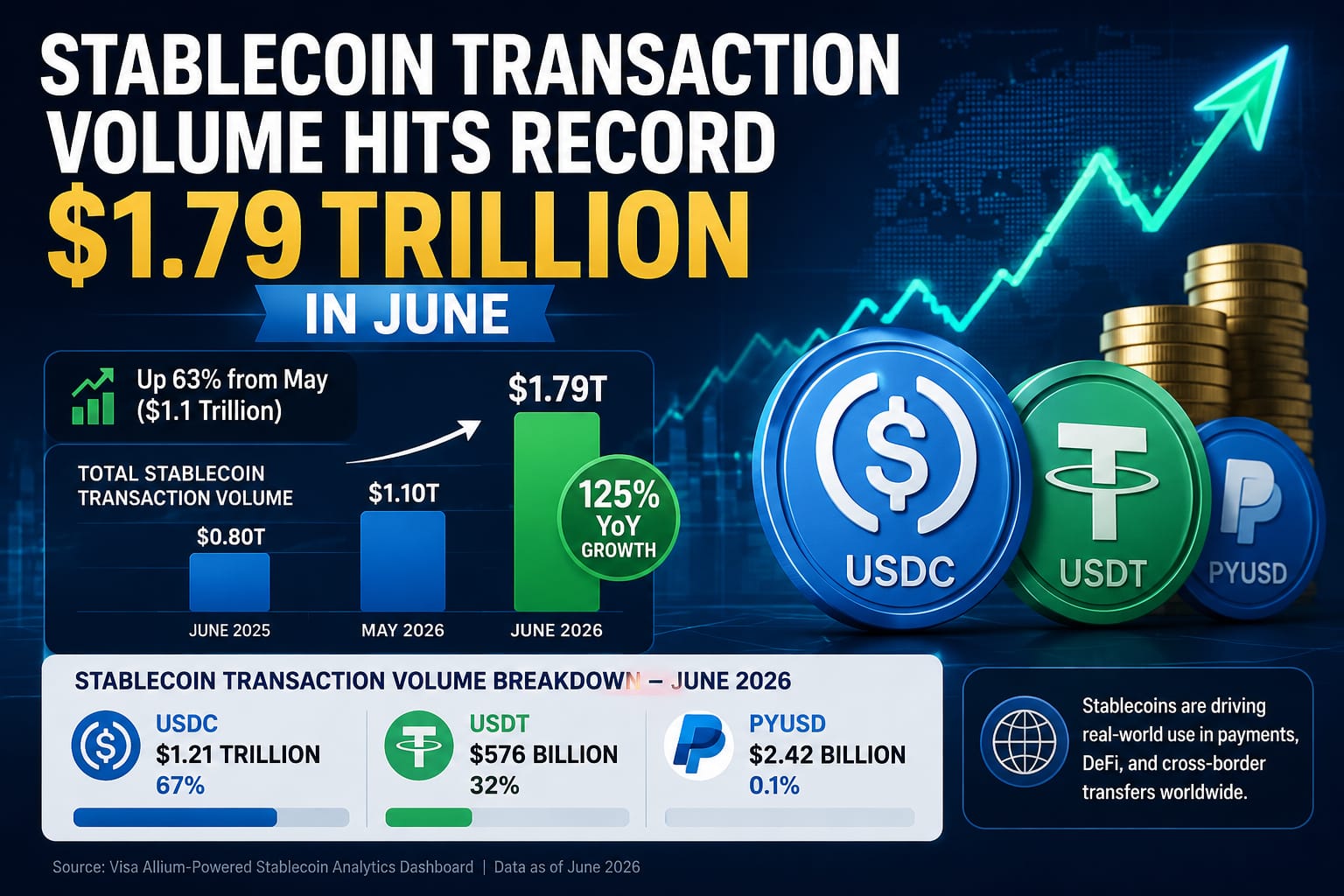
According to data from global payments company Visa, stablecoin transaction volume surged significantly during June. The total adjusted volume reached $1.79 trillion, marking a strong increase from May’s $1.1 trillion. This represents a monthly growth of approximately 63%, showing that stablecoin adoption continues to expand at a rapid pace.
Stablecoin New Record Surpasses Previous High
The June total surpassed the previous all-time high of $1.78 trillion, which was recorded in February 2026. The latest data also shows impressive year-over-year growth. Compared with June of the previous year, transaction volume increased by 125%, demonstrating how quickly stablecoins are becoming a key part of the digital asset ecosystem.
Visa’s stablecoin analytics platform, powered by blockchain data provider Allium, tracks transaction activity across major stablecoin networks. The dashboard revealed that June was one of the strongest months ever for stablecoin usage.
Zach Pandl, Head of Research at Grayscale, noted that June 2026 set another record for stablecoin transaction activity, narrowly exceeding the previous peak reached earlier in the year. His comments reflect the growing attention that stablecoins are receiving from investors, businesses, and financial institutions worldwide.
What Is Driving the Growth?
The sharp increase in stablecoin transactions suggests that these digital assets are being used for much more than cryptocurrency trading. Stablecoins are increasingly supporting real-world financial activities, making them one of the most practical applications of blockchain technology.
Unlike traditional cryptocurrencies such as Bitcoin or Ethereum, stablecoins are designed to maintain a stable value, usually by being linked to the U.S. dollar. This stability makes them attractive for payments, transfers, and financial services.
Several factors are contributing to the growth of stablecoin usage:
1. Faster Payments
Stablecoins allow users to send money quickly across blockchain networks. Transactions can often be completed within minutes, regardless of geographic location.
2. Cross-Border Transfers
International money transfers through traditional banking systems can be expensive and slow. Stablecoins offer a more efficient alternative, helping individuals and businesses move funds across countries at lower costs.
3. Decentralized Finance (DeFi)
The decentralized finance sector continues to rely heavily on stablecoins. These assets are widely used for lending, borrowing, trading, and earning yields within blockchain-based financial platforms.
4. Growing Crypto Infrastructure
As blockchain technology becomes more advanced and user-friendly, stablecoins are becoming easier to access and use. Improved infrastructure has encouraged wider adoption among consumers and businesses alike.
Stablecoins Thrive Despite Market Challenges
One of the most notable aspects of the latest data is that stablecoin activity continues to grow even during a broader downturn in the cryptocurrency market.
While many digital assets have experienced price declines and reduced investor enthusiasm, stablecoins have remained highly active. This suggests that their role has evolved beyond simple trading tools.
Instead of relying solely on speculation, stablecoins are increasingly being used for practical financial purposes. As a result, they have become one of the strongest and most resilient segments of the crypto industry.
Their steady growth during a difficult market environment indicates that demand for digital payment solutions remains strong.
USDC Leads Transaction Volume
Although Tether’s USDT remains the largest stablecoin by market capitalization, Circle’s USDC dominated transaction activity during June.
According to Visa’s data:
- USDC recorded approximately $1.21 trillion in transaction volume.
- USDT generated around $576 billion in transaction volume.
This means USDC accounted for roughly 67% of all stablecoin transaction volume during the month, while USDT represented about 32%.
The strong performance of USDC highlights its growing popularity among businesses, institutions, and blockchain applications. Many users prefer USDC because of its transparency, regulatory focus, and widespread integration across financial platforms.
PayPal’s PYUSD Continues to Grow
PayPal’s stablecoin, PYUSD, ranked third in terms of transaction volume during June.
The stablecoin generated approximately $2.42 billion in transaction activity during the month. While this figure is much smaller than the volumes recorded by USDC and USDT, it demonstrates that newer stablecoins are gradually gaining traction in the market.
As large financial companies continue to enter the stablecoin sector, competition is expected to increase, potentially driving innovation and broader adoption.
Future Outlook for Stablecoins
The record transaction volume recorded in June highlights the growing role of stablecoins in the global financial system. Their ability to provide fast, low-cost, and reliable digital payments is attracting users from both the crypto industry and traditional finance.
As governments develop clearer regulations and blockchain technology continues to improve, stablecoins could become even more widely used for everyday transactions, business payments, remittances, and financial services.
The latest figures suggest that stablecoins are no longer just a supporting part of the cryptocurrency market. Instead, they are becoming one of the industry’s most important growth drivers, helping bridge the gap between traditional finance and the digital economy.
With transaction volumes reaching new highs and adoption continuing to expand, stablecoins appear well-positioned to play a larger role in the future of global payments and digital finance.