
World Markets End Week Lower as AI Stock Rally Fades and Crude Oil Climbs
Global financial markets faced a challenging trading session on Friday, July 17, 2026, as investors reacted to a combination of technology sector weakness, disappointing corporate earnings, and rising geopolitical tensions in the Middle East. Stock markets across the world witnessed sharp fluctuations, while oil prices surged and cryptocurrencies struggled to maintain recent gains.
The week ended with increased uncertainty among investors as concerns about artificial intelligence valuations, global economic stability, and energy supply disruptions weighed heavily on market sentiment.
U.S. Stock Markets Finish Lower
Major U.S. stock indexes closed in negative territory, ending their recent winning streaks and posting weekly losses. Investors moved away from high-growth technology stocks, leading to broad market weakness.
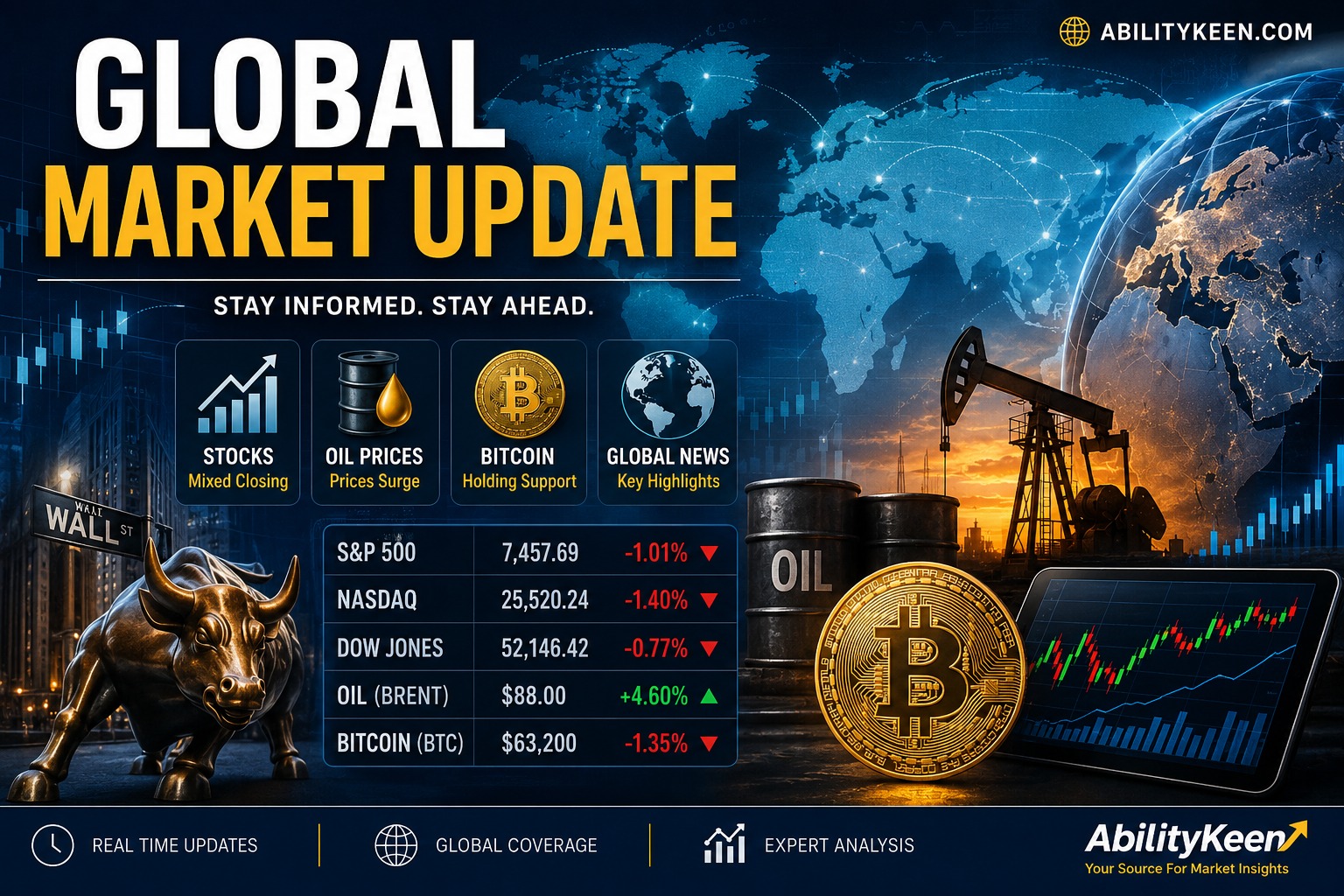
The S&P 500 fell by 1.01% to close at 7,457.69, recording a weekly loss of 1.6%. The Nasdaq Composite, which is heavily influenced by technology companies, suffered the biggest decline among major indexes. It dropped 1.40% to end the session at 25,520.24 and lost 2.9% for the week.
Meanwhile, the Dow Jones Industrial Average slipped 0.77% and finished at 52,146.42, ending the week with a loss of 0.9%.
The decline reflected growing investor concerns about the future growth potential of some of the market’s most valuable technology companies.
Technology Stocks Under Heavy Pressure
One of the biggest stories of the week was the sharp sell-off in semiconductor and artificial intelligence-related stocks.
Over the past few years, investors have poured billions of dollars into AI-focused companies, expecting rapid growth and major technological breakthroughs. However, recent market activity suggests that some investors are beginning to question whether the massive spending on AI infrastructure can justify the extremely high valuations seen across the sector.
Adding to the uncertainty was the launch of a new advanced AI system from Chinese company Moonshot AI. The development increased competitive pressure within the industry and raised questions about which companies will ultimately dominate the AI market.
As a result, major chipmakers came under significant selling pressure. Nvidia, one of the biggest beneficiaries of the AI boom, experienced a notable decline. Other semiconductor giants, including AMD and Intel, also faced strong downward momentum as investors reduced exposure to technology stocks.
The three-day semiconductor sell-off became one of the key factors behind the broader market weakness.
Corporate Earnings Create Mixed Reactions
Corporate earnings reports also influenced market performance.
Streaming giant Netflix disappointed investors after releasing a third-quarter growth outlook that fell short of Wall Street expectations. The company also reduced the amount of customer engagement data it plans to share with investors, creating additional uncertainty.
As a result, Netflix shares plunged more than 7%, making it one of the biggest losers among large-cap technology companies during the session.
However, not all sectors struggled.
The insurance industry delivered strong results, with The Travelers Companies reporting better-than-expected second-quarter earnings. Investors responded positively to the earnings beat, sending the stock up approximately 9%.
The contrasting performances highlighted how investors are becoming increasingly selective, rewarding companies with strong financial results while punishing those that fail to meet expectations.
Asian Markets Feel the Impact
The technology sell-off was not limited to the United States. Asian stock markets experienced significant declines earlier in the trading day as investors reacted to the weakness in global technology shares.
Japan’s Nikkei 225 index dropped 5.2%, pushing the market into correction territory. Taiwan’s benchmark stock index also suffered a sharp decline, falling 5.7%.
Both markets have strong exposure to semiconductor and technology companies, making them particularly vulnerable to shifts in investor sentiment toward the AI and chip sectors.
The losses in Asia demonstrated how closely connected global financial markets have become, with developments in one region quickly influencing trading activity around the world.
Oil Prices Surge on Middle East Developments
While stock markets struggled, oil prices moved sharply higher.
Energy markets reacted to reports of escalating military activity in the Middle East. Expanded U.S. airstrikes targeting locations in Iran and retaliatory attacks affecting infrastructure in Kuwait raised concerns about potential disruptions to regional energy supplies.
As a result, Brent crude oil climbed 4.6%, reaching around $88 per barrel. The move pushed oil prices to their highest level in roughly a month.
Rising oil prices are often viewed as a risk for the global economy because they can increase transportation, manufacturing, and energy costs. Higher energy prices can also contribute to inflation, making it more difficult for central banks to control price pressures.
Investors will continue to monitor developments in the region closely, as further escalation could have a significant impact on global energy markets.
Bitcoin Shows Relative Resilience
The cryptocurrency market also experienced some weakness, but digital assets generally held up better than many technology stocks.
Bitcoin traded around the $63,200 level after failing to maintain momentum above $65,000 earlier in the week. Although the world’s largest cryptocurrency moved lower, the decline was relatively modest compared to the sharp losses seen in several technology and semiconductor stocks.
Many market participants view Bitcoin as increasingly separate from traditional technology investments, although it still remains sensitive to changes in investor risk appetite.
Traders are now watching whether Bitcoin can hold key support levels and potentially regain upward momentum if broader market conditions improve.
Global Market Outlook
Looking ahead, investors are expected to focus on several key themes. The future of artificial intelligence spending, upcoming corporate earnings reports, geopolitical developments in the Middle East, and movements in oil prices will likely remain major drivers of market sentiment.
The recent volatility serves as a reminder that financial markets can change direction quickly when economic uncertainty, geopolitical risks, and shifting investor expectations come together.
For now, investors appear to be taking a more cautious approach as they assess whether the recent technology sell-off represents a temporary pullback or the beginning of a broader market correction. As global markets enter a new trading week, all eyes will remain on technology stocks, energy prices, and international developments that could shape the next major market move.