
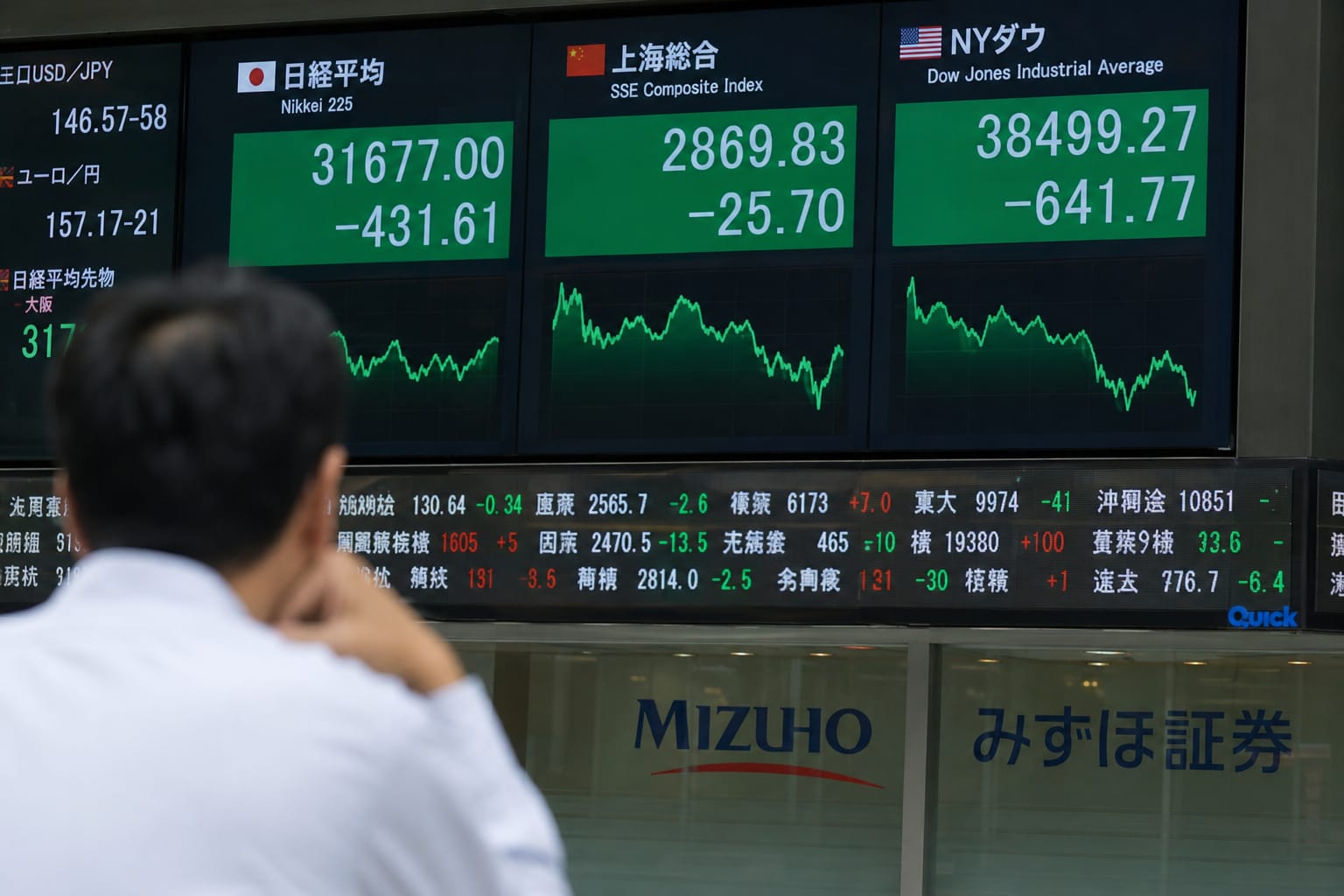
Asia Markets Fall as Global Tech Sell-Off Deepens
Asian stock markets ended mostly lower as investors reacted to a broad sell-off in global technology shares. Weakness in major tech companies, concerns about slowing market momentum, and renewed geopolitical tensions in the Middle East weighed on investor confidence across the region. While stock markets struggled, oil prices moved higher after reports of an oil tanker incident near the strategically important Strait of Hormuz.
Oil Prices Climb Amid Middle East Tensions
Oil prices gained ground during Asian trading sessions as traders monitored rising geopolitical risks in the Middle East. Market participants became concerned after an oil tanker was reportedly hit near the Strait of Hormuz, one of the world’s most important shipping routes for crude oil.
Brent crude futures rose above $72 per barrel, while U.S. West Texas Intermediate crude traded above $69 per barrel. The incident reminded investors that energy supply risks remain present despite recent diplomatic efforts and peace agreements in the region.
The Strait of Hormuz plays a crucial role in global energy transportation, and any disruption in the area can quickly affect oil markets worldwide. As a result, traders increased their focus on potential supply risks, helping push crude prices higher.
Japanese Markets Fall as Technology Stocks Decline
Japan’s stock market experienced significant losses, with the benchmark Nikkei 225 index falling more than 2%. The broader Topix index also moved lower as technology-related companies faced heavy selling pressure.
Several semiconductor and electronics companies suffered double-digit declines. Investors reduced exposure to technology stocks amid growing concerns about the sector’s valuation and future growth prospects.
Major technology names such as SoftBank Group, Tokyo Electron, Advantest, Murata Manufacturing, and Fanuc all recorded notable losses during the session. The weakness in Japanese technology stocks reflected broader concerns spreading through global markets.
Despite the overall market decline, Sapporo Breweries stood out as a bright spot. The company gained strongly after announcing a partnership with Danish brewing giant Carlsberg. The joint venture aims to expand Sapporo’s presence across Southeast Asia and Hong Kong.
The company plans to invest hundreds of millions of dollars into the partnership and expects attractive long-term returns. Management also outlined ambitious growth plans for Sapporo Premium Beer sales in the region over the next decade.
Japan’s Consumer Spending Shows Mixed Signals
Economic data from Japan offered some positive news despite ongoing challenges. Household spending declined compared to the same period last year, marking the sixth consecutive month of contraction. However, the decline was much smaller than economists had expected.
Monthly spending figures showed a strong improvement, recording the fastest increase in several months. Consumers spent more on food, housing, healthcare, clothing, and education, while spending on transportation, communication, and recreation remained relatively weak.
The data suggests that while Japanese consumers remain cautious, some areas of domestic demand are showing signs of stabilization.
Chinese and Hong Kong Markets Move Lower
Chinese stock markets also ended the day in negative territory. Both the Shanghai Composite Index and the Shenzhen Component Index recorded losses as investors remained cautious about economic growth prospects and global market conditions.
Several companies in sectors such as real estate and industrial services posted sharp declines, adding pressure to the broader market.
In Hong Kong, the Hang Seng Index slipped as investors reacted to news involving major technology firms. Shares of Kuaishou Technology dropped sharply after reports indicated that technology giant Tencent had reduced its stake in the company through a large share sale.
The discounted share sale created concerns about future demand for Kuaishou stock and triggered heavy selling. Other major Hong Kong-listed companies, including BYD Electronic International and CMOC Group, also traded lower.
South Korea Faces Sharpest Market Decline
South Korea experienced the steepest losses among major Asian markets. The Kospi index plunged more than 5% as technology stocks came under intense pressure.
Investors were particularly disappointed by the reaction to earnings guidance from Samsung Electronics. Despite forecasting record second-quarter profits, Samsung shares fell sharply. The decline suggested that investors had already priced in strong earnings expectations and were looking for even stronger signals of future growth.
Other major technology firms, including SK Hynix and Samsung Electro-Mechanics, also suffered significant losses.
Adding to the market’s weakness, Hanwha Ocean plunged after losing a major international defense contract. The company had been competing to build Canada’s next generation of submarines, but the project was awarded to Thyssenkrupp Marine Systems instead.
The heavy selling pressure became so severe that South Korean regulators temporarily halted trading through a circuit breaker mechanism after the market fell sharply.
Australia and New Zealand Also Weaken
Australian shares moved lower as weakness in mining and resource companies weighed on the market. Companies involved in lithium, rare earth minerals, and coal production recorded some of the largest declines of the day.
In New Zealand, the market remained relatively stable compared to its regional peers. The benchmark index finished almost unchanged, although several healthcare and transportation companies posted modest losses.
Currency Markets Show Mixed Performance
Currency markets were relatively calm compared to equity markets. The U.S. dollar weakened slightly against the Japanese yen but strengthened against both the Australian and New Zealand dollars.
The mixed performance reflected ongoing uncertainty about global economic conditions, interest rate expectations, and investor risk appetite.
Global Investors Remain Focused on Technology Sector
The biggest theme driving markets remains the technology sector. Investors have relied heavily on technology and artificial intelligence-related stocks to fuel global market gains over the past year. However, recent trading sessions suggest that momentum may be slowing.
Market participants are becoming more selective as valuations remain elevated and expectations continue to rise. Even companies reporting strong earnings are finding it difficult to satisfy increasingly demanding investors.
Asian markets faced widespread selling pressure as a global technology stock pullback reduced investor confidence. South Korea recorded the largest losses, while Japan, China, Hong Kong, and Australia also ended lower. At the same time, rising oil prices highlighted the impact of geopolitical risks on financial markets.
Going forward, investors will closely watch corporate earnings reports, developments in the technology sector, central bank policies, and geopolitical events. These factors are expected to play a major role in determining market direction during the coming weeks.