
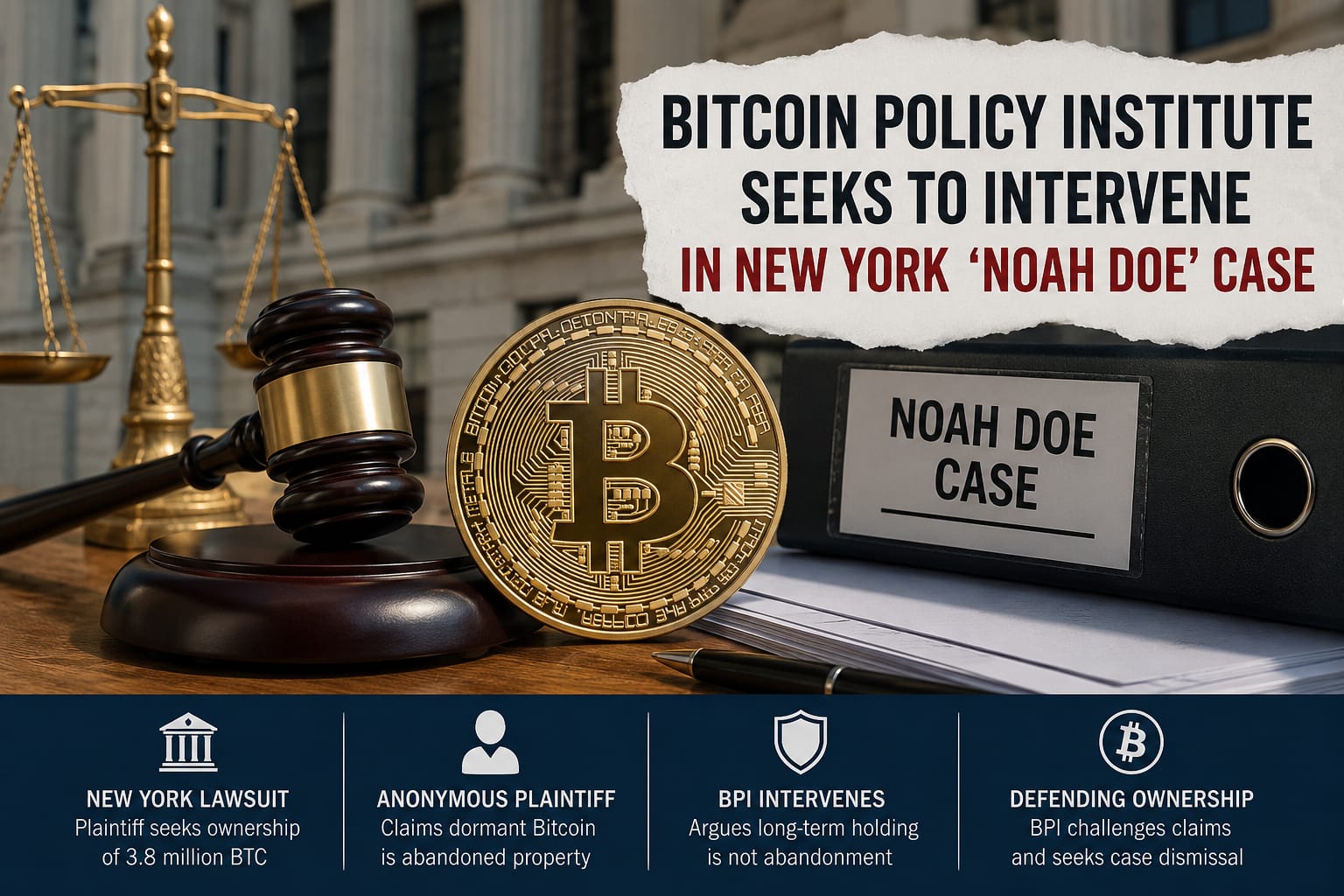
Bitcoin Policy Institute Wants to Join New York “Noah Doe” Bitcoin Lawsuit
A major legal dispute involving millions of dormant Bitcoin has taken a new turn after the Bitcoin Policy Institute (BPI) asked to join the case as a defendant. The organization believes that the outcome of the lawsuit could have a significant impact on Bitcoin holders who keep their assets untouched for long periods of time.
According to reports, the Bitcoin Policy Institute filed an application with the New York State Supreme Court on July 10, requesting permission to participate in the legal proceedings surrounding the so-called “Noah Doe” case. The institute is being represented by the international law firm White & Case. Alex Thorn, Head of Research at Galaxy Research, stated that BPI has already submitted a proposed response to the lawsuit, along with 15 affirmative defenses, and intends to seek dismissal of the case.
What Is the “Noah Doe” Case?
The Noah Doe case has attracted attention across the cryptocurrency industry because it involves a huge amount of Bitcoin that has remained inactive for many years.
An anonymous plaintiff filed the lawsuit in New York, arguing that approximately 3.8 million Bitcoin should be considered abandoned property under New York’s Abandoned Property Law. These coins are connected to around 39,069 Bitcoin addresses that have shown little or no activity over an extended period.
The claim is particularly notable because some of the addresses included in the lawsuit are believed to be associated with Bitcoin creator Satoshi Nakamoto. Since these wallets have remained untouched for many years, the plaintiff argues that the assets should be legally treated as abandoned and transferred under state law.
If successful, the lawsuit could create a major legal precedent regarding ownership rights of inactive digital assets.
Why Does the Bitcoin Policy Institute Want to Get Involved?
The Bitcoin Policy Institute says it has a direct interest in the case because it holds Bitcoin reserves in self-custody for long-term investment purposes.
In its filing, BPI explained that its own Bitcoin holdings could fit the plaintiff’s definition of “abandoned” assets because they are intended to be held for a long time without frequent transactions. The organization argues that if the court accepts the plaintiff’s interpretation of abandonment, many legitimate Bitcoin owners could face legal risks simply because they choose not to move or sell their coins.
For this reason, BPI believes it has the legal right to participate in the lawsuit and defend the interests of long-term Bitcoin holders.
The institute maintains that the case goes beyond the specific wallets named in the lawsuit and could affect anyone who stores Bitcoin for years without making transactions.
BPI Challenges the Plaintiff’s Arguments
The Bitcoin Policy Institute strongly disagrees with the legal theory presented in the lawsuit and has outlined several reasons why it believes the case should not succeed.
One of BPI’s key arguments is that knowing a Bitcoin address does not prove ownership of the assets associated with that address. The organization compares a public Bitcoin address to a bank account number. Simply knowing an account number does not make someone the owner of the funds inside the account.
According to BPI, Bitcoin addresses are publicly visible by design, but ownership is determined by possession of the private keys that control those addresses. Without access to the private keys, no one can claim ownership of the Bitcoin.
Another argument raised by BPI concerns the nature of Bitcoin wallets. The institute states that wallets do not actually exist on the blockchain itself. Instead, wallets are tools that manage cryptographic keys, which allow users to access and control their Bitcoin. Because of this, BPI argues that the plaintiff’s understanding of wallet ownership is fundamentally flawed.
Long-Term Holding Is Not Abandonment
Perhaps the most important point raised by the Bitcoin Policy Institute is that inactivity should not be confused with abandonment.
Many Bitcoin investors intentionally hold their assets for long periods without moving them. This strategy, often referred to as “HODLing” in the crypto community, is a common investment approach used by individuals, companies, and institutions.
BPI argues that choosing not to sell or transfer Bitcoin does not mean the owner has given up ownership rights. Instead, it may simply reflect a long-term investment strategy.
The organization warns that treating inactive Bitcoin as abandoned property could create uncertainty for millions of cryptocurrency users worldwide. Investors who store assets securely for years could potentially face legal challenges despite never intending to relinquish ownership.
Potential Impact on the Crypto Industry
The Noah Doe case is being closely watched because its outcome could influence how courts view dormant cryptocurrency assets in the future.
If the plaintiff’s arguments are accepted, it could open the door to new claims involving inactive Bitcoin wallets and other digital assets. On the other hand, if the court rejects the theory, it may reinforce the principle that ownership remains with the holder regardless of how long the assets remain untouched.
For now, the Bitcoin Policy Institute is seeking permission to officially join the case and present its arguments before the court.
The Bitcoin Policy Institute has stepped into the spotlight by requesting to become a defendant in the high-profile Noah Doe lawsuit in New York. The case centers on whether millions of dormant Bitcoin should be considered abandoned property. BPI argues that long-term holding is a normal part of Bitcoin investing and should not be treated as abandonment. With billions of dollars in digital assets potentially affected, the lawsuit could become one of the most important legal battles in the cryptocurrency industry and may help define future ownership rights for Bitcoin holders around the world.