
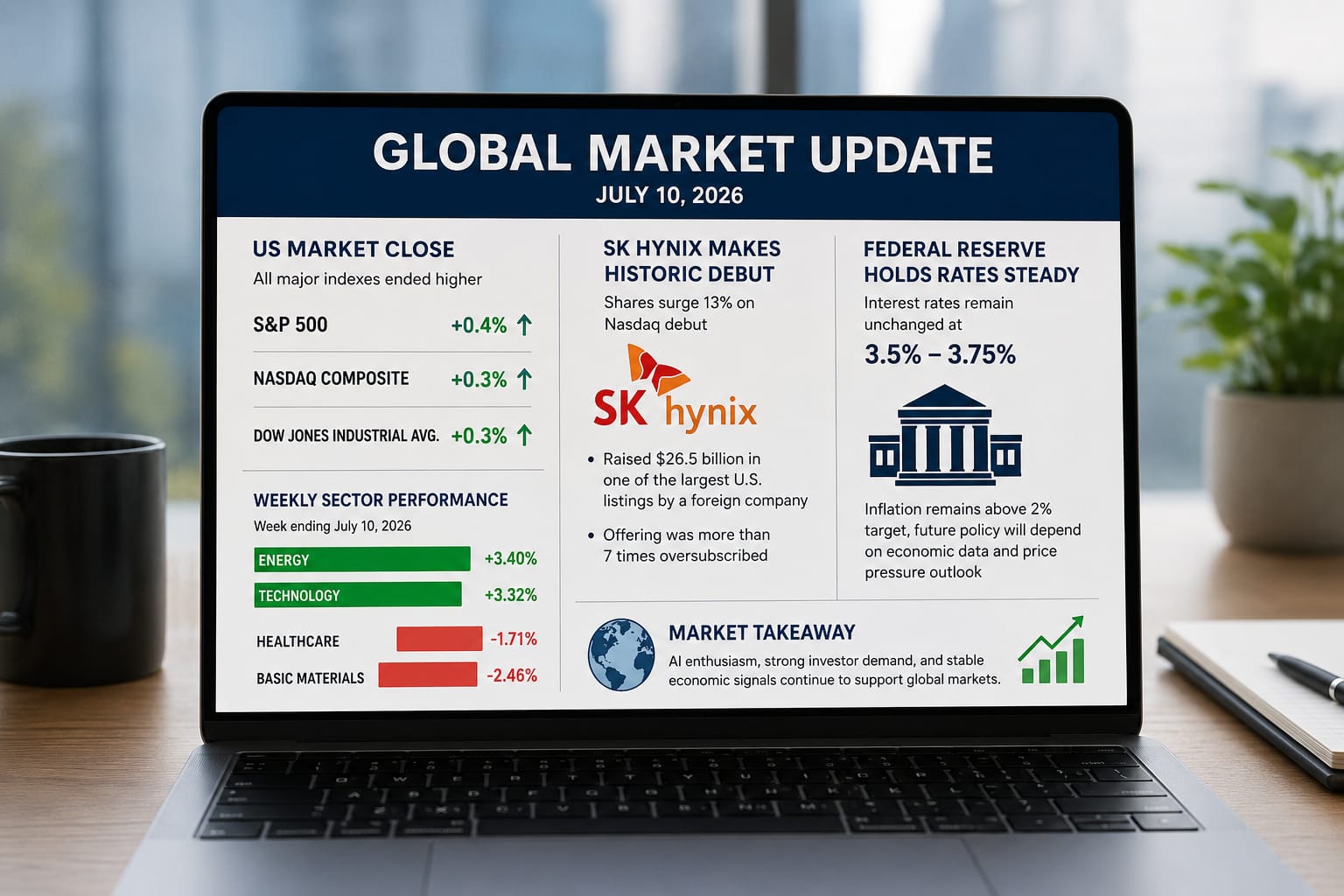
Global Market Update: US Stocks Rise on AI Optimism as SK Hynix Surges in Nasdaq Debut
Global financial markets ended the week on a positive note as investors remained focused on the growth potential of artificial intelligence (AI), strong corporate performances, and signals from central banks. Despite ongoing geopolitical concerns around the world, major US stock indexes continued their upward momentum, helping global market sentiment remain largely positive.
The week ending July 10, 2026, saw strong performances from technology and energy stocks, while investors closely monitored inflation trends and interest rate decisions from the US Federal Reserve. A major highlight of the week was the successful Nasdaq debut of South Korean chipmaker SK Hynix, which attracted significant attention from global investors.
US Stock Market Ends Higher
The US stock market closed higher on July 10, extending its recent winning streak. The benchmark S&P 500 index gained 0.4%, marking its fourth positive week in the last five weeks. The steady rise reflected growing investor confidence in the strength of the US economy and the continued expansion of the artificial intelligence industry.
The Nasdaq Composite, which is heavily weighted toward technology companies, climbed 0.3%. Meanwhile, the Dow Jones Industrial Average also advanced 0.3%, supported by gains in banking and technology stocks.
Investors continued to show strong interest in companies connected to AI development, including semiconductor manufacturers, cloud computing providers, and software firms. The rapid adoption of AI technologies across industries has created expectations of long-term earnings growth, helping push stock prices higher.
Although geopolitical tensions remain a concern for global markets, investors largely focused on corporate earnings and economic fundamentals during the week.
AI Boom Continues to Support Markets
Artificial intelligence remains one of the biggest themes in global financial markets. Companies involved in AI infrastructure, data centers, semiconductors, and cloud services continue to attract investor attention.
The growing demand for advanced chips and computing power is benefiting technology companies around the world. Investors believe AI could transform multiple industries, including healthcare, finance, manufacturing, and transportation, creating significant growth opportunities over the coming years.
This optimism has played a major role in supporting stock market gains throughout 2026. Many analysts believe AI-related investments could remain a key market driver in the months ahead.
SK Hynix Makes a Strong Nasdaq Debut
One of the biggest stories of the week came from South Korea, where memory chip giant SK Hynix made its highly anticipated debut on the Nasdaq stock exchange.
The company’s shares surged 13% on their first day of trading, reflecting strong investor demand. The listing raised approximately $26.5 billion, making it one of the largest US stock offerings by a foreign company.
Investor interest in the offering was extremely strong, with reports indicating that demand exceeded available shares by more than seven times. The successful debut highlights the growing importance of semiconductor companies in the AI era.
SK Hynix is considered one of the world’s leading producers of memory chips, which are essential components in AI servers, data centers, smartphones, and other advanced technologies. As demand for AI infrastructure continues to expand, companies like SK Hynix are expected to play a crucial role in supporting future technological growth.
Federal Reserve Holds Interest Rates Steady
Another major event for financial markets was the latest policy meeting of the US Federal Reserve.
In the first Federal Open Market Committee (FOMC) meeting chaired by Kevin Warsh, policymakers decided to keep interest rates unchanged within a range of 3.5% to 3.75%.
The decision was widely expected by market participants. Federal Reserve officials acknowledged that inflation remains above their long-term target of 2%, but they also noted signs of improvement in recent months.
Falling oil prices have helped ease some inflation pressures, although policymakers remain cautious. The central bank emphasized that future interest rate decisions will depend on incoming economic data and how quickly inflation continues to decline.
Investors generally welcomed the Fed’s balanced approach. Stable interest rates provide businesses and consumers with greater certainty while allowing policymakers additional time to assess economic conditions.
Energy and Technology Sectors Lead the Way
Sector performance showed a clear preference among investors for energy and technology stocks during the week.
The energy sector emerged as the best-performing group, gaining 3.40%. Strong demand expectations and improved commodity market conditions helped support energy-related companies.
Technology stocks were close behind, rising 3.32% during the week. Continued enthusiasm around AI, semiconductor companies, and cloud computing businesses fueled the sector’s strong performance.
These gains demonstrate how investors are focusing on industries with strong growth potential and improving earnings prospects.
Healthcare and Materials Lag Behind
While some sectors enjoyed strong gains, others faced challenges.
The basic materials sector recorded the weakest performance of the week, declining 2.46%. Concerns about global economic growth and fluctuating commodity prices weighed on investor sentiment.
Healthcare stocks also struggled, finishing the week down 1.71%. Some investors shifted funds toward higher-growth sectors such as technology and energy, resulting in weaker demand for healthcare shares.
Despite these declines, analysts note that sector rotation is a normal part of market behavior, especially during periods when investors are seeking exposure to fast-growing industries.
Global Market Outlook
Looking ahead, investors will continue monitoring inflation data, corporate earnings reports, and developments in the AI industry. The Federal Reserve’s future policy decisions will remain a major factor influencing global markets.
For now, optimism surrounding artificial intelligence, stable economic growth, and strong investor demand for technology-related companies continues to support market momentum.
If inflation continues to ease and economic conditions remain stable, global stock markets could see further gains in the second half of 2026. However, investors will also keep a close eye on geopolitical developments and economic data that could influence market direction in the coming weeks.