
Oil Prices Slip as OPEC+ Increases Production, Markets Watch Supply Trends
Global oil prices moved lower on Monday after the Organization of the Petroleum Exporting Countries (OPEC) and its allies agreed to increase crude oil production once again. The decision comes at a time when shipping activity through the important Strait of Hormuz is recovering, raising concerns that global oil supplies could become more abundant in the coming months.
OPEC+ Announces Another Production Increase
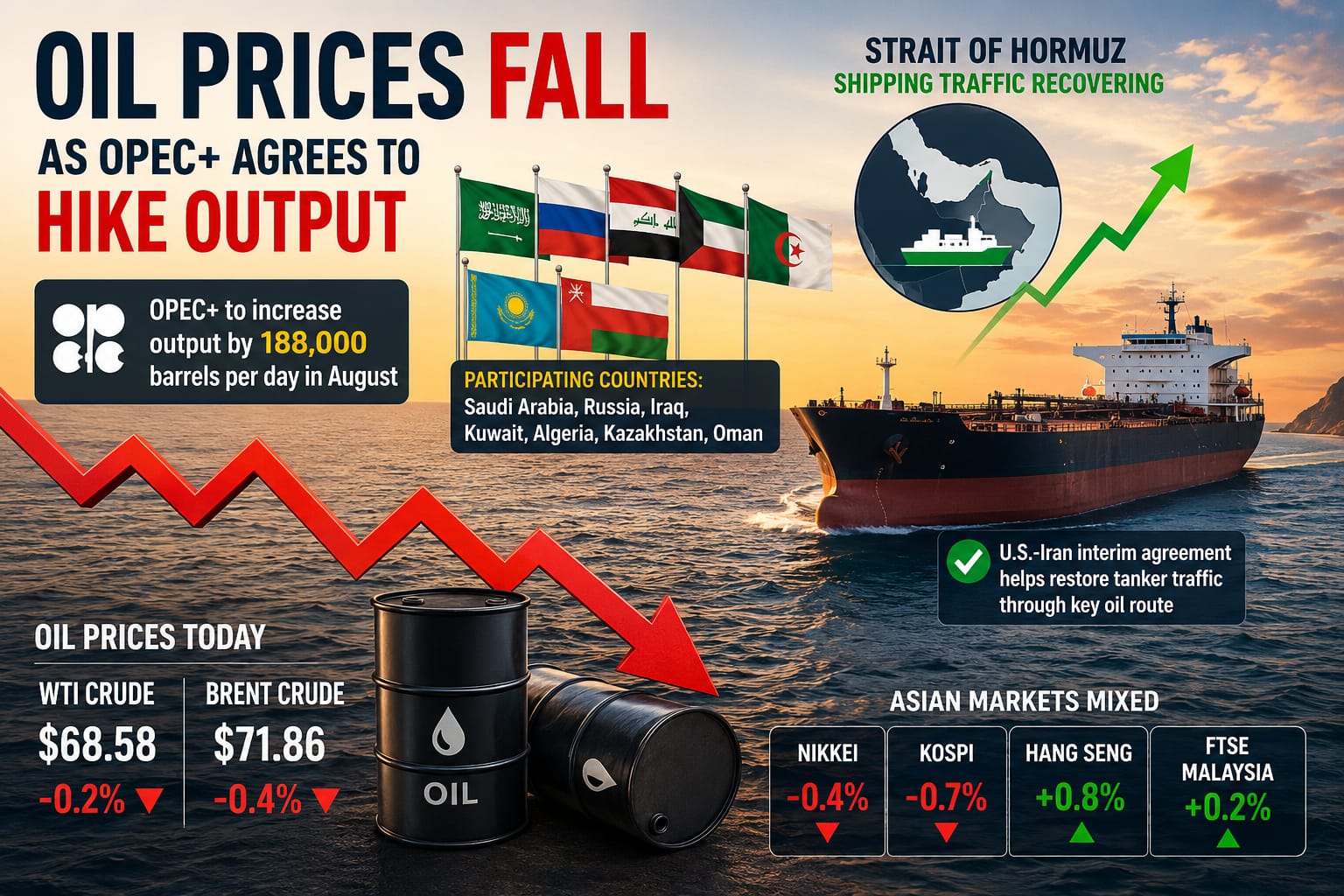
During a virtual meeting held on Sunday, members of the OPEC+ alliance decided to raise oil production by around 188,000 barrels per day in August. This marks the fifth straight month that the group has increased output.
The countries taking part in the production increase include Saudi Arabia, Russia, Iraq, Kuwait, Algeria, Kazakhstan, and Oman. Saudi Arabia, which is widely seen as the leading force within OPEC+, continues to play a major role in shaping the group’s production strategy.
The latest increase reflects the group’s confidence in market conditions and its effort to balance global supply and demand. However, the decision has also sparked concerns that the market may soon face an oversupply of crude oil.
Recovery in Strait of Hormuz Shipping Activity
Another important factor influencing oil prices is the improving situation in the Strait of Hormuz. This narrow waterway is one of the most critical oil transportation routes in the world, with roughly 20% of global oil shipments typically passing through it.
Shipping traffic in the region had faced disruptions due to tensions between the United States and Iran. However, conditions have improved since both countries reached an interim agreement in mid-June aimed at reducing conflict and reopening safe passage through the Strait.
As a result, oil and gas tanker movements have gradually started returning to normal levels. The recovery in shipping activity means more oil can reach global markets, which may further increase supply.
Analysts believe that the combination of higher OPEC+ production and improving shipping conditions could put additional pressure on oil prices if demand does not rise at the same pace.
Concerns About a Possible Oil Surplus
Market experts are closely watching the impact of these developments. Analysts at Commerzbank Research noted that tanker traffic through the Strait of Hormuz is steadily recovering following the agreement between the United States and Iran.
According to the analysts, the return of shipping activity, combined with OPEC+’s latest production increase, has increased worries about the possibility of a global crude oil surplus.
When oil supply grows faster than demand, prices often come under pressure. Investors are therefore monitoring production levels, economic growth, and energy demand trends to determine whether the market can absorb the additional barrels entering circulation.
Oil Futures Trade Lower
Oil futures prices experienced a volatile trading session on Monday. Prices moved between gains and losses before ultimately ending lower during Asian trading hours.
West Texas Intermediate (WTI), the main benchmark for U.S. crude oil, fell by around 0.2% to $68.58 per barrel. Earlier in the session, WTI had risen as much as 0.6% before reversing course and briefly dropping nearly 0.9%.
Brent crude, the international benchmark used by many countries, also weakened. Brent futures declined approximately 0.4% to $71.86 per barrel after fluctuating between gains and losses during the day.
The movement highlights the uncertainty among traders as they evaluate the impact of rising supply and improving transportation routes.
Mixed Performance Across Asian Stock Markets
While oil markets reacted negatively to the supply news, Asian stock markets showed mixed results on Monday.
Japan’s Nikkei Stock Average fell by 0.4%, reflecting cautious investor sentiment. South Korea’s Kospi Index also declined, losing around 0.7%.
On the other hand, some markets managed to post gains. Hong Kong’s Hang Seng Index rose by 0.8%, supported by buying interest in selected sectors. Malaysia’s FTSE Bursa Malaysia KLCI Index edged 0.2% higher, showing modest strength despite broader market uncertainty.
The mixed performance across Asian markets indicates that investors are balancing concerns about energy prices with optimism surrounding economic growth and corporate earnings.
What Investors Are Watching Next
The focus for energy investors now shifts to future demand trends and whether global consumption can keep pace with increasing supply.
If OPEC+ continues raising production and shipping through the Strait of Hormuz returns fully to normal, the global oil market could see more barrels available than previously expected. In such a scenario, oil prices may face additional downward pressure.
However, strong economic activity, seasonal energy demand, and unexpected supply disruptions could still provide support for crude prices in the months ahead.
For now, traders remain cautious as they assess the combined impact of higher OPEC+ output and improving transportation conditions. These developments are likely to remain key drivers of oil market sentiment throughout the remainder of the summer.