
Global Markets Fall as Semiconductor Stocks Slide, Oil Prices Rise, and Fed Rate Concerns Grow in July 2026
Global financial markets faced pressure in early July 2026 as investors became more cautious about the outlook for technology stocks, rising oil prices, and future interest rate decisions. After months of strong gains driven by artificial intelligence (AI) enthusiasm, many semiconductor and technology stocks experienced a pullback, leading major U.S. stock indexes to close lower.
The decline came as investors reassessed high valuations in the technology sector, watched growing tensions in the Middle East, and considered the possibility that interest rates could remain high for a longer period.
U.S. Stock Markets End Lower
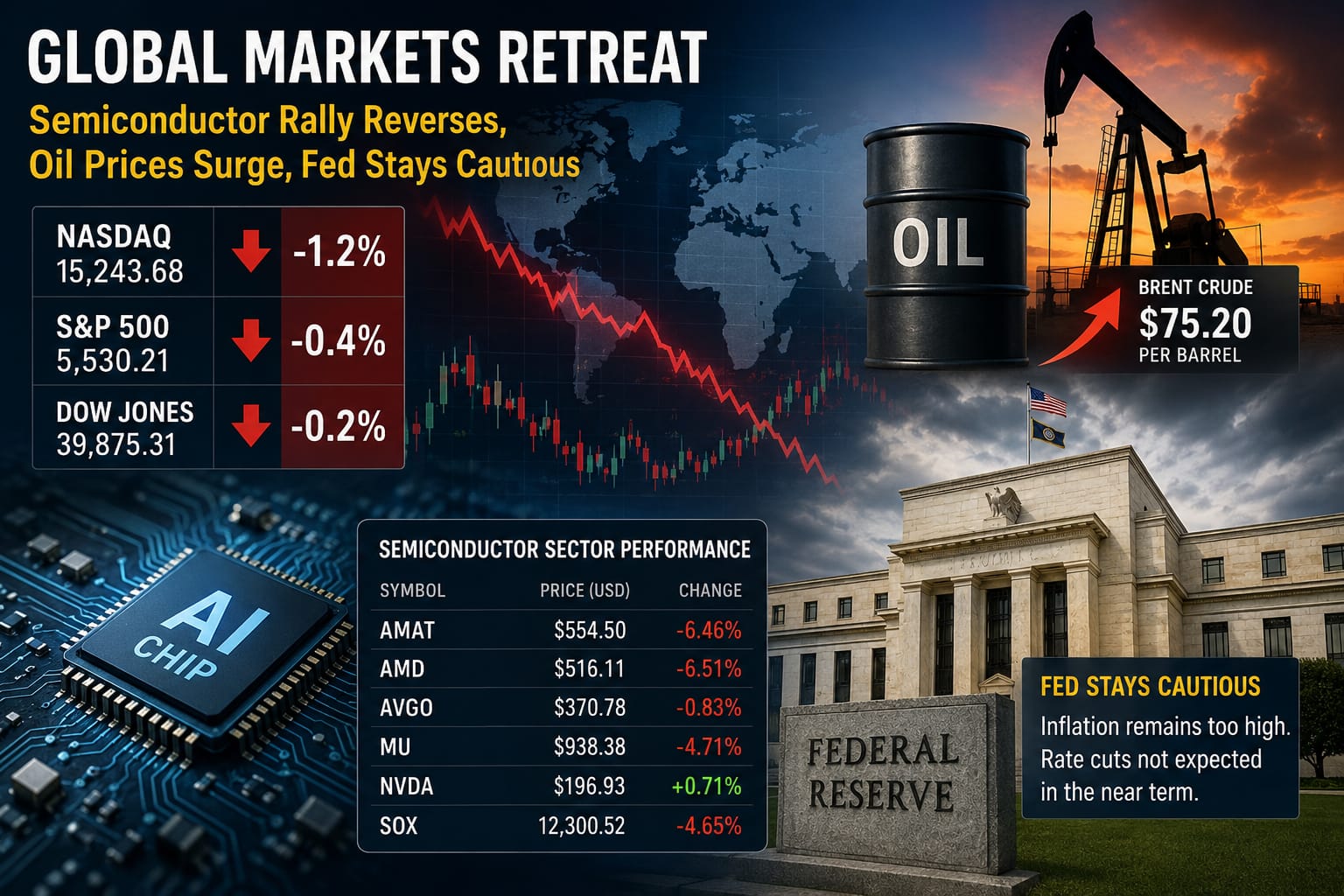
On July 7, 2026, major U.S. stock indexes closed in negative territory. The technology-heavy Nasdaq Composite recorded the biggest decline, falling 1.2%. The S&P 500 lost 0.4%, while the Dow Jones Industrial Average slipped 0.2%.
Although the Dow briefly reached a new intraday record high during trading, selling pressure later pushed the index lower. Investors who had enjoyed strong gains from technology and AI-related stocks in the first half of the year began taking profits, resulting in a broad market retreat.
The semiconductor industry, which had been one of the strongest-performing sectors of 2026, became the center of the market correction.
Semiconductor Rally Faces a Major Test
Semiconductor companies had delivered impressive returns during the first six months of 2026, with many stocks rising more than 80%. The rapid growth was fueled by increasing demand for AI chips, data center infrastructure, and cloud computing services.
However, as share prices climbed, valuations became increasingly expensive. Many institutional investors and hedge funds decided to secure profits, triggering a wave of selling across the semiconductor sector.
Several major chipmakers experienced significant declines:
- Applied Materials fell more than 6%.
- AMD dropped over 6%.
- Micron Technology lost nearly 5%.
- Broadcom recorded a modest decline.
- The Philadelphia Semiconductor Index (SOX) fell around 4.6%.
Interestingly, NVIDIA managed to remain relatively stable and even posted a small gain, reflecting continued confidence in its leadership position within the AI chip market.
Investors Question AI Spending Returns
Another factor affecting market sentiment is growing concern about the financial returns from massive AI investments.
Over the last two years, major technology companies have spent enormous amounts on AI infrastructure. While investors initially welcomed these investments, some are now asking when these projects will begin generating meaningful profits.
The world’s largest technology companies—including Microsoft, Meta, Alphabet, and Amazon—are expected to spend approximately $725 billion on AI infrastructure during 2026. This would represent a massive 77% increase compared with the previous year.
Microsoft alone is expected to spend around $190 billion as it continues expanding its AI capabilities through Azure cloud services. Meanwhile, Meta has increased its projected spending to between $125 billion and $145 billion, citing rising hardware costs and growing demand for advanced AI systems.
Despite this spending boom, investors remain uncertain about how quickly these investments will translate into stronger earnings and long-term profitability.
AI Continues to Drive Chip Demand
Even though semiconductor stocks have recently pulled back, demand for AI-related hardware remains extremely strong.
Generative AI chips, including graphics processing units (GPUs) and AI accelerators, are expected to generate nearly $500 billion in revenue during 2026. This would represent almost half of the entire global semiconductor market.
The AI boom is creating demand across multiple areas:
High-Performance AI Chips
Companies continue to purchase advanced AI processors to train and run large language models and other AI applications. Demand for NVIDIA’s latest chips remains exceptionally high.
Memory Chips
The rapid growth of AI systems requires large amounts of High-Bandwidth Memory (HBM). Rising HBM prices have strengthened demand for memory manufacturers such as Micron Technology.
Custom AI Processors
Major technology companies are increasingly developing their own specialized chips. Microsoft’s Maia processors and Meta’s MTIA chips are examples of custom silicon designed to improve efficiency and reduce dependence on third-party suppliers.
Data Center Networking
The construction of large AI data centers is also increasing demand for networking and connectivity hardware. Broadcom expects AI-related semiconductor revenue to continue growing strongly over the coming years.
Rising Oil Prices Add New Pressure
While technology stocks were under pressure, geopolitical developments created additional concerns for investors.
Oil prices surged after reports of attacks on commercial vessels in the Strait of Hormuz. The situation raised fears about potential disruptions to global energy supplies.
Following the incidents, the United States took action by revoking licenses related to Iranian oil sales and carrying out retaliatory measures. As a result, Brent crude oil prices climbed above $75 per barrel.
Higher oil prices often contribute to inflation by increasing transportation and production costs. This creates another challenge for financial markets because persistent inflation can influence central bank policies.
Federal Reserve Remains Cautious
Investors are also closely monitoring the U.S. Federal Reserve.
Federal Reserve officials have repeatedly stated that inflation remains above their target level. As a result, policymakers are not yet ready to begin aggressive interest rate cuts.
Recent economic data, particularly strong employment figures, have reinforced expectations that interest rates could stay elevated for an extended period. Some market participants even believe another rate increase remains possible before the end of 2026 if inflation fails to slow further.
Higher interest rates generally have a larger impact on growth-oriented sectors such as technology because they reduce the present value of future earnings.
Market Outlook
Although the recent decline has created short-term uncertainty, the long-term outlook for artificial intelligence and semiconductor industries remains positive. Demand for AI infrastructure continues to grow rapidly, and major technology companies are still investing heavily in next-generation computing systems.
However, investors are becoming more selective as they balance strong growth opportunities against high valuations, geopolitical risks, and interest rate uncertainty.
For now, global markets appear to be entering a period of caution after an extraordinary technology rally. The coming months will likely depend on inflation trends, Federal Reserve decisions, oil price movements, and whether AI investments begin delivering the financial returns investors expect.