
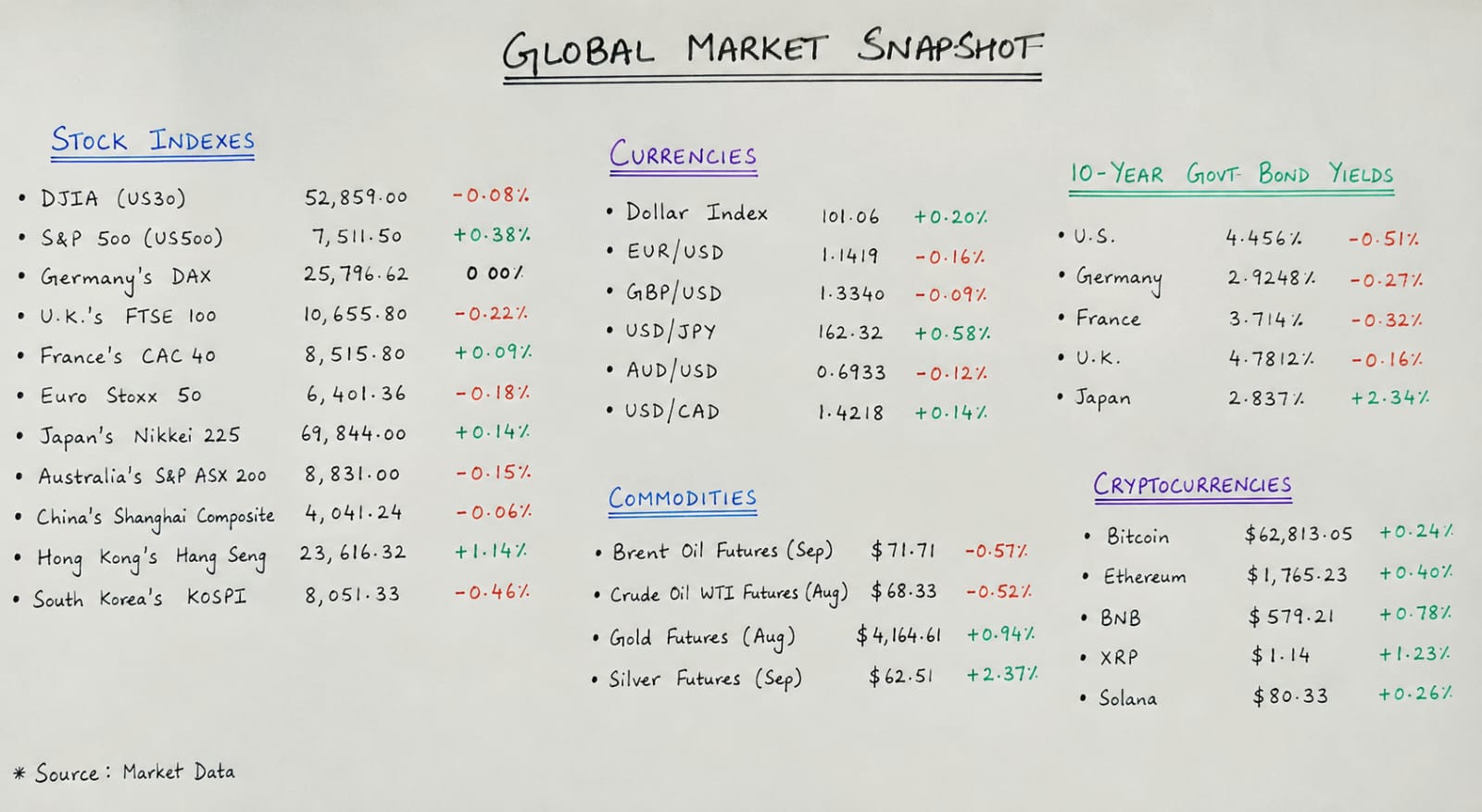
Global Markets Show Mixed Trends as Investor Confidence Improves
Global financial markets displayed a mixed performance as investor sentiment improved following encouraging developments in the technology sector and signs of a softer U.S. labor market. Market participants are also closely watching upcoming signals from the U.S. Federal Reserve regarding future interest rate decisions.
The latest economic data from the United States has helped ease concerns about aggressive monetary tightening, leading investors to reassess expectations for future rate hikes. While uncertainty remains, the overall mood across global markets has become more positive compared to earlier in the week.
Softer U.S. Jobs Data Supports Market Sentiment
One of the key factors supporting global markets is the recent U.S. employment report, which indicated a slower pace of job market growth. Investors generally view weaker labor market data as a sign that inflation pressures could ease, reducing the need for the Federal Reserve to raise interest rates aggressively.
According to market expectations tracked by interest rate traders, the probability of a quarter-point rate increase by the Federal Reserve in July has fluctuated in recent days. Current expectations stand at around 24%, compared to 18% a day earlier and 30% earlier in the week. This changing outlook reflects uncertainty over the direction of U.S. monetary policy.
Investors are now awaiting the release of the latest Federal Open Market Committee (FOMC) meeting minutes, which could provide further clues about the central bank’s thinking on inflation, economic growth, and future interest rates.
U.S. Markets Deliver Mixed Performance
Wall Street futures remained largely directionless as traders preferred to stay cautious ahead of the Fed minutes. Among major U.S. indexes, performance was mixed.
The Dow Jones Industrial Average slipped slightly by 0.08% to 52,859.00. Meanwhile, the broader S&P 500 index gained 0.38% to reach 7,511.50, supported by strength in technology-related stocks.
The resilience of the technology sector continues to play an important role in supporting investor confidence, especially as companies benefit from growing demand for artificial intelligence and digital services.
European Markets Trade on a Mixed Note
European stock markets also showed mixed trends during the session. Germany’s DAX index remained nearly unchanged at 25,796.62, while France’s CAC 40 edged higher by 0.09% to 8,515.80.
On the other hand, the United Kingdom’s FTSE 100 declined 0.22% to 10,655.80, reflecting cautious investor sentiment. The Euro Stoxx 50 index also moved slightly lower, falling 0.18% to 6,401.36.
European investors continue to balance optimism over improving global growth prospects against concerns about inflation and economic challenges within the region.
Asian Markets End Session with Mixed Results
Asian stock markets closed with varied performances. Japan’s Nikkei 225 rose 0.14% to 69,844.00, supported by export-oriented companies benefiting from a weaker Japanese yen.
Hong Kong’s Hang Seng Index was among the strongest performers, gaining 1.14% to close at 23,616.32. Investor interest in technology and financial stocks helped lift the market.
However, not all Asian markets moved higher. South Korea’s KOSPI fell 0.46%, while China’s Shanghai Composite Index slipped 0.06%. Australia’s S&P/ASX 200 also ended slightly lower, down 0.15%.
The mixed performance highlights ongoing caution among investors despite improving sentiment globally.
Currency Markets Favor the U.S. Dollar
In currency trading, the U.S. dollar strengthened against most major currencies. The Dollar Index rose 0.20% to 101.06, supported largely by weakness in the Japanese yen.
The USD/JPY pair climbed 0.58% to 162.32, reflecting continued pressure on Japan’s currency. Meanwhile, the euro and British pound weakened modestly against the dollar.
EUR/USD declined 0.16% to 1.1419, while GBP/USD slipped 0.09% to 1.3340. The Australian dollar and Canadian dollar also traded lower against the greenback.
Bond Markets Show Diverging Trends
Government bond yields mostly moved lower across major economies, indicating demand for safer assets.
The yield on the benchmark 10-year U.S. Treasury note fell to 4.456%. German, French, and U.K. government bond yields also recorded small declines.
Japan was the exception, with its 10-year government bond yield rising 2.34% to 2.837%. The increase reflects ongoing speculation regarding future policy changes by the Bank of Japan.
Oil Prices Fall After OPEC+ Output Decision
Energy markets came under pressure after OPEC+ agreed to increase production targets. Higher output expectations raised concerns about additional supply entering the market.
Brent crude oil futures dropped 0.57% to $71.71 per barrel, while U.S. West Texas Intermediate (WTI) crude fell 0.52% to $68.33 per barrel.
The decline suggests that traders expect increased oil production to help balance global demand and supply conditions in the coming months.
Gold, Silver, and Cryptocurrencies Move Higher
Precious metals attracted buying interest as investors sought alternative assets amid economic uncertainty.
Gold futures climbed 0.94% to $4,164.61, while silver futures surged 2.37% to $62.51, making silver one of the strongest-performing assets of the day.
The cryptocurrency market also traded in positive territory. Bitcoin rose 0.24% to $62,813.05, while Ethereum gained 0.40% to $1,765.23.
Other major digital assets posted gains as well. BNB increased 0.78%, XRP advanced 1.23%, and Solana moved up 0.26%.
Global Market Outlook
Global markets are currently balancing optimism about easing inflation pressures with caution ahead of important central bank updates. Strong performance in technology stocks and softer U.S. economic data have helped improve investor confidence, but uncertainty surrounding future interest rate decisions remains a key focus.
As traders await the release of the Federal Reserve’s meeting minutes, market volatility could remain elevated. Investors will continue monitoring economic data, central bank commentary, commodity prices, and geopolitical developments for clues about the next direction of global financial markets.