
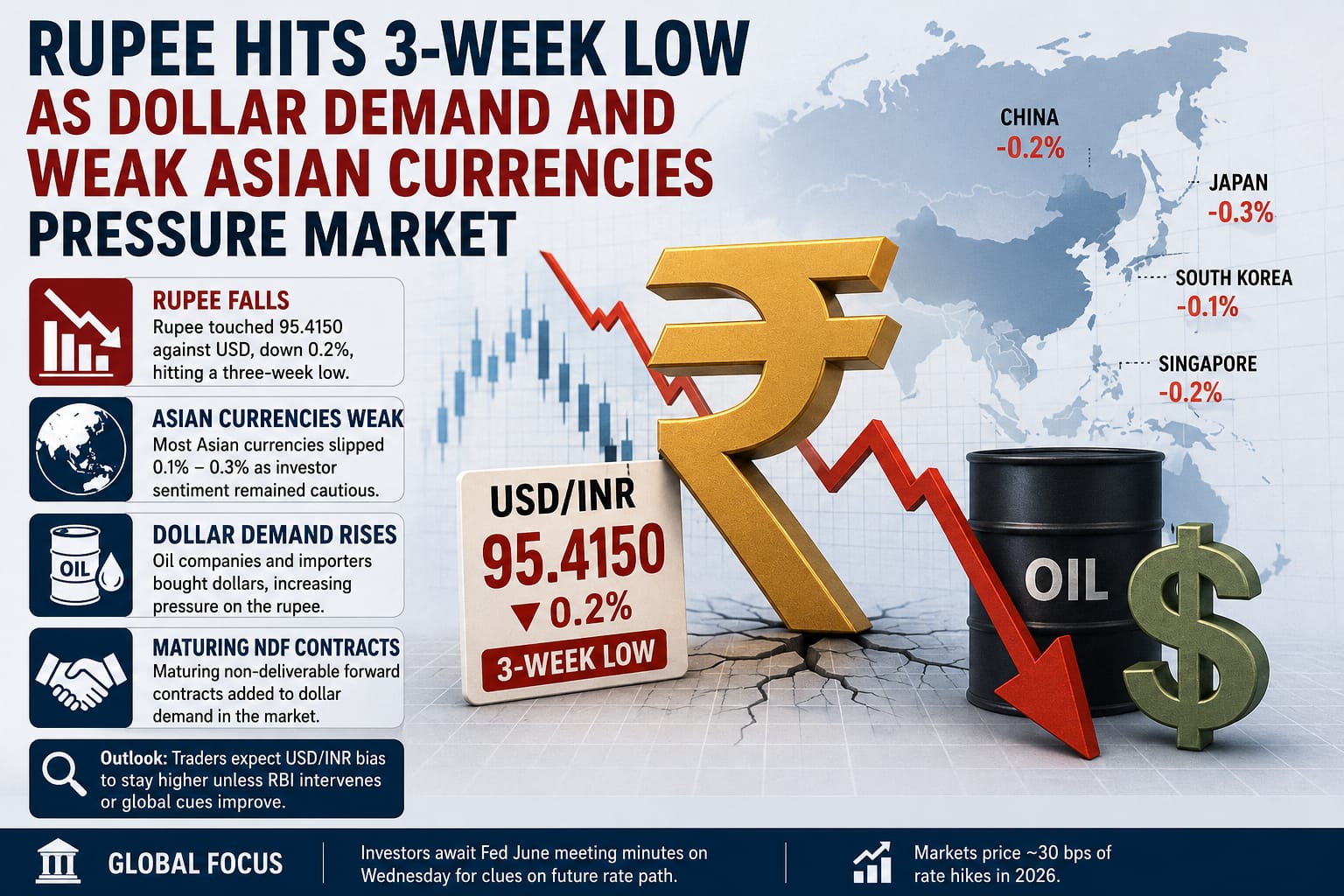
Rupee Falls to Three-Week Low as Dollar Demand and Weak Asian Currencies Weigh on Market
The Indian rupee weakened against the U.S. dollar on Monday, following losses seen in other Asian currencies. Strong demand for dollars from local oil companies and importers also added pressure on the Indian currency, pushing it to its lowest level in nearly three weeks.
The rupee touched 95.4150 against the U.S. dollar during the trading session, marking a decline of around 0.2% for the day. Market participants said that a combination of regional currency weakness and increased demand for dollars in the domestic market contributed to the fall.
Asian Currencies Move Lower
Most Asian currencies traded lower on Monday as investors remained cautious about the global economic outlook. Regional currencies slipped between 0.1% and 0.3%, reflecting a stronger demand for the U.S. dollar in foreign exchange markets.
Although the U.S. dollar index remained close to a two-week low, Asian currencies still struggled to gain strength. Investors continued to monitor economic developments in the United States and expectations surrounding future interest rate decisions by the Federal Reserve.
Currency markets across Asia often move together, and weakness in regional currencies tends to influence the Indian rupee as well. As a result, the rupee followed the broader trend and came under pressure.
Dollar Demand from Oil Companies Adds Pressure
Apart from regional factors, domestic demand for dollars also played an important role in weakening the rupee.
Traders noted that Indian oil companies were actively buying dollars to meet their import payment requirements. Since India imports a large portion of its crude oil needs, oil firms regularly purchase dollars to settle international transactions.
When demand for dollars increases, it usually puts downward pressure on the rupee because more market participants are exchanging rupees for U.S. currency.
Importers from other sectors were also seen buying dollars, which further increased pressure on the local currency during the trading session.
Impact of Maturing Forward Contracts
Market participants also pointed to demand linked to maturing contracts in the non-deliverable forward (NDF) market.
The NDF market allows traders and investors to hedge currency risks without physically exchanging the underlying currency. When these contracts mature, participants often need to adjust their positions, creating additional demand or supply in the currency market.
According to traders, the maturity of certain NDF contracts generated additional demand for dollars in the interbank market. This contributed to the rupee’s weakness during the day.
The Reserve Bank of India’s daily reference rate, commonly known as the RBI fix, was trading at a premium of around 0.25 to 0.50 paisa. Market experts said this reflected stronger demand for dollars and increased activity related to expiring contracts.
Traders See Further Upside in USD/INR
Many currency traders believe the USD/INR pair could continue moving higher if current market conditions remain unchanged.
According to traders, the overall trend still favors the U.S. dollar against the rupee. In the absence of significant intervention from the Reserve Bank of India, market participants expect the pair to remain supported.
Central bank interventions can sometimes help stabilize currency movements by increasing the supply of dollars or buying local currency. However, traders indicated that there has been limited resistance from policymakers so far, allowing market forces to influence exchange rates.
As a result, the outlook for USD/INR remains positive from the dollar’s perspective, meaning the rupee could stay under pressure in the near term.
Focus Shifts to Federal Reserve Meeting Minutes
Global investors are now closely watching the release of the minutes from the U.S. Federal Reserve’s June policy meeting, scheduled for Wednesday.
The meeting minutes could provide valuable insights into how Federal Reserve officials view inflation, economic growth, and the future path of interest rates.
Any signals regarding future rate decisions could have a significant impact on currency markets worldwide, including the Indian rupee.
Higher U.S. interest rates generally make dollar-denominated assets more attractive to investors, supporting the value of the U.S. currency. Conversely, signs of lower rates could weaken the dollar and provide relief to emerging-market currencies.
Market Expectations on U.S. Interest Rates
While investors continue to monitor Federal Reserve policy, some analysts believe market expectations for future U.S. rate increases may currently be too aggressive.
Analysts at financial institution MUFG noted that interest rate expectations remain relatively high. They suggested that if upcoming economic data supports a softer outlook, U.S. interest rates could gradually move lower over time.
Such a scenario could reduce support for the dollar and potentially help emerging-market currencies recover some ground.
According to data from market tracking services, interest rate futures currently indicate expectations of around 30 basis points of additional rate increases during the remainder of 2026.
These expectations will likely continue to influence currency movements in the coming months as investors assess incoming economic reports and central bank guidance.
Outlook for the Indian Rupee
The Indian rupee faces multiple challenges in the short term. Weakness in Asian currencies, strong dollar demand from oil importers, and activity related to maturing forward contracts are all contributing to downward pressure.
At the same time, global investors remain focused on U.S. interest rate expectations and Federal Reserve policy signals. Any major shift in those expectations could influence the direction of both the dollar and the rupee.
For now, the rupee remains under pressure after touching a three-week low, while traders continue to watch domestic dollar demand and upcoming global economic developments for further clues about the currency’s next move.